Working memory is a mental system that temporarily holds and actively uses information, helping you perform tasks like solving problems, making decisions, or following instructions.
Think of it like a mental workspace or scratchpad that allows your brain to juggle and process several pieces of information at once.
Working memory has a limited capacity (around 7 ± 2 items or only a handful of chunks).
Key Parts
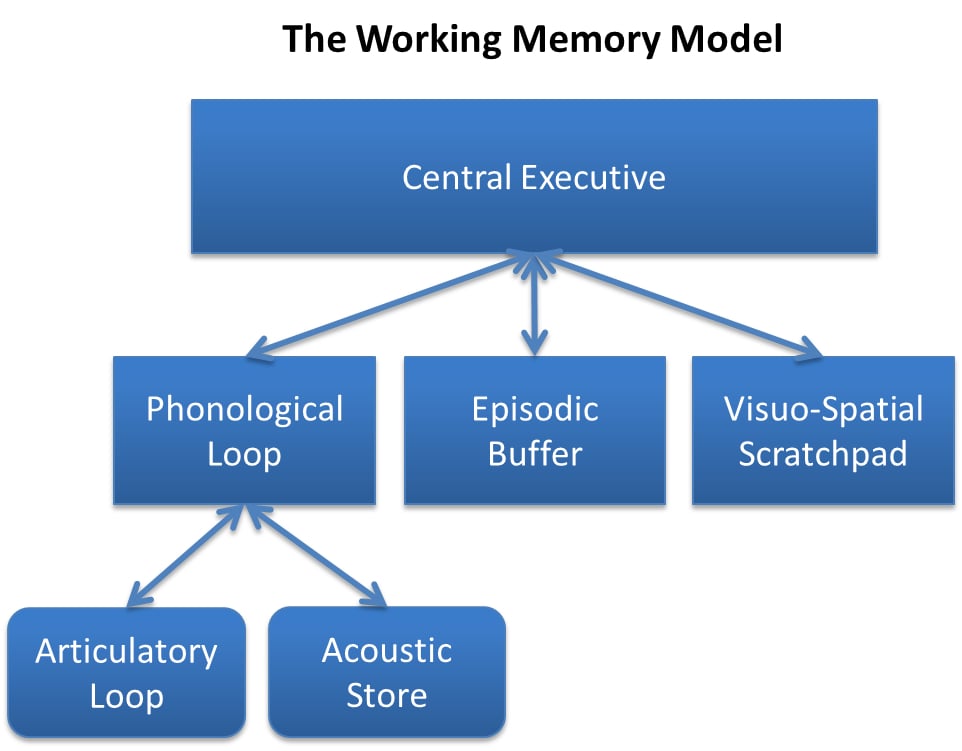
The Working Memory Model, proposed by Baddeley and Hitch in 1974, describes short-term memory as a system with multiple components.
- Central Executive: Acts like a manager, deciding what to focus on, organizing tasks, and directing information to the right places in your mind. It also deals with cognitive tasks such as mental arithmetic and problem-solving.
- Phonological Loop: Deals with spoken and written words and has two parts: Inner ear: Briefly holds words or sounds you hear (for about 1–2 seconds). Inner voice: Repeats words or sounds in your mind, helping you remember them.
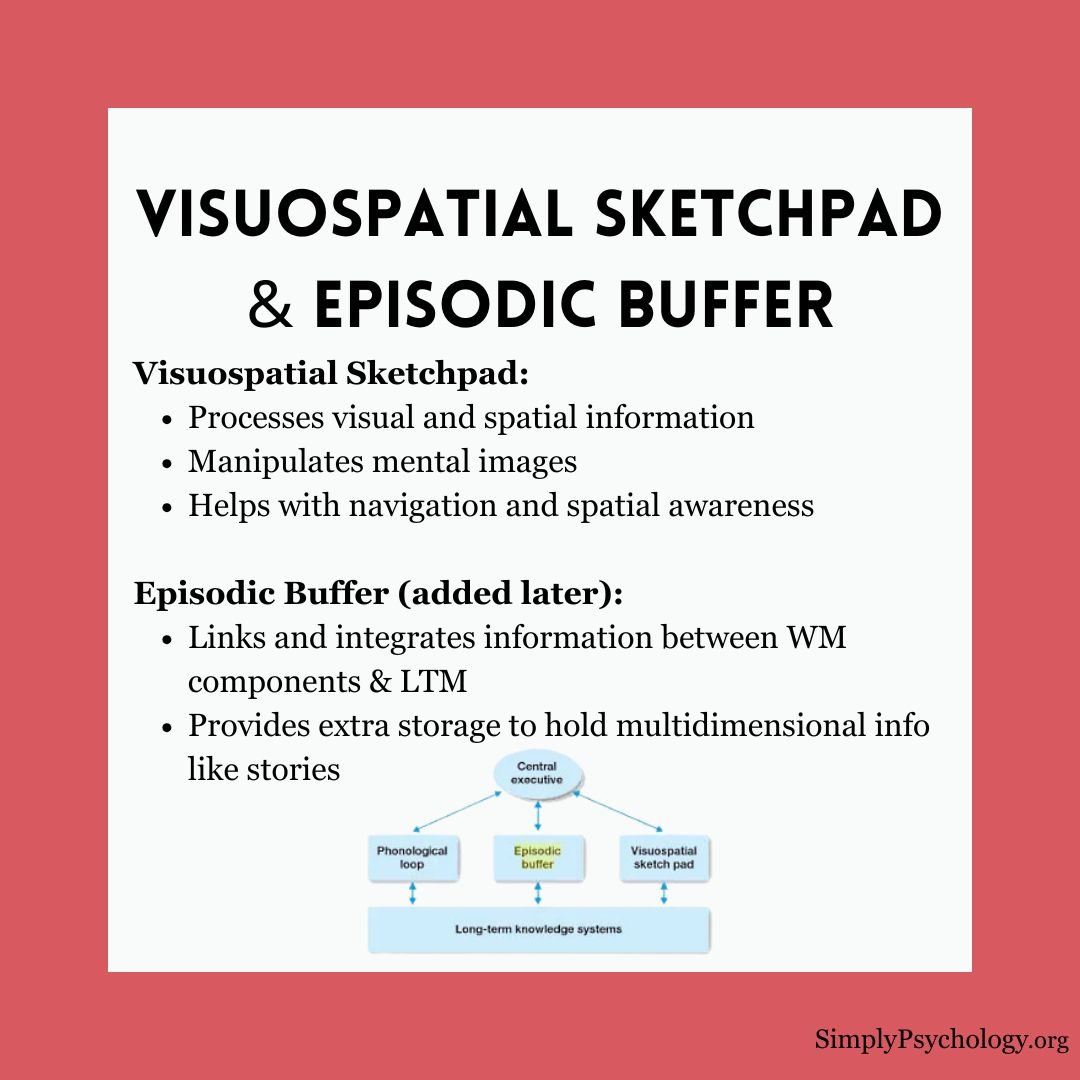
- Visuospatial Sketchpad: Works like your mind’s eye, handling visual images and spatial relationships—like picturing a room layout or finding your way around a new place.
- Episodic Buffer: Acts as a mental connector, bringing together information from different sources (visual, verbal, memories) to help you form complete stories or experiences, and links this to your long-term memory.

How it differs from short-term memory
Short-term memory keeps information for a brief period, like holding a phone number before dialing.
Working memory goes beyond simple storage; it actively manipulates and processes information.
Think of it as a mental workspace or a whiteboard in your mind, where you not only keep track of information temporarily but also do something with it, like solving a math problem, following driving directions, or planning what you want to say next in a conversation.
Key Differences:
- Activity Level: Short-term memory is primarily passive storage. Working memory actively engages with the stored information, processing, rearranging, or evaluating it.
- Complexity: Working memory involves multiple components, such as visual imagery (imagining scenes or routes), verbal rehearsal (repeating information mentally), and an executive function that directs your attention and coordinates your actions.
- Everyday Use: Short-term memory is used for simple tasks like remembering brief details momentarily. Working memory supports complex cognitive tasks, such as decision-making, problem-solving, and learning new information.
In short, while short-term memory temporarily holds information, working memory actively uses, manipulates, and processes it, making it crucial for everyday thinking, reasoning, and planning.
Why is working memory important?
Working memory is important because it’s a mental workspace that helps you hold and use information while performing everyday tasks.
It allows you to follow instructions, solve problems, learn new skills, and make decisions. In education, it’s key to reading, writing, and math.
People with stronger working memory often do better academically, as they can easily manage and apply new information.
Working memory also supports essential skills such as reasoning, organizing thoughts, planning, and multitasking, making it vital for navigating daily life and achieving goals.
What are everyday examples of working memory?
Everyday examples of working memory include:
- Remembering instructions like following a recipe while cooking.
- Doing mental math, such as calculating the total cost of groceries while shopping.
- Holding directions in mind while navigating a route.
- Keeping track of a conversation, allowing you to listen and respond effectively.
- Taking notes during a meeting or class, as you remember what was just said while writing it down.
- Recalling a phone number long enough to dial it.
These activities rely on working memory because they require you to hold and use information actively and briefly in your mind.
What strategies improve working memory?
While direct training typically doesn’t boost working memory itself, you can effectively support your working memory using these practical strategies:
- Break tasks down into smaller, manageable steps.
- Use memory aids like lists, notes, or reminders.
- Create clear routines to automate daily tasks.
- Group or “chunk” information into smaller sets.
- Practice mental rehearsal by repeating information to yourself.
- Reduce distractions by creating quiet, organized workspaces.
- Connect new information to things you already know (use existing knowledge).
How does stress impact working memory?
Stress impacts working memory by making it harder to focus and keep track of information.
When you’re stressed or anxious, your brain uses up mental resources trying to manage those feelings, leaving fewer resources available for handling the tasks you’re working on.
This makes it difficult to concentrate, hold details in your mind, and effectively manage complex tasks.
For example, if you’re nervous during an exam or stressed at work, you might struggle to remember instructions or perform mental calculations, because stress interferes with the brain’s ability to organize and manipulate information effectively.
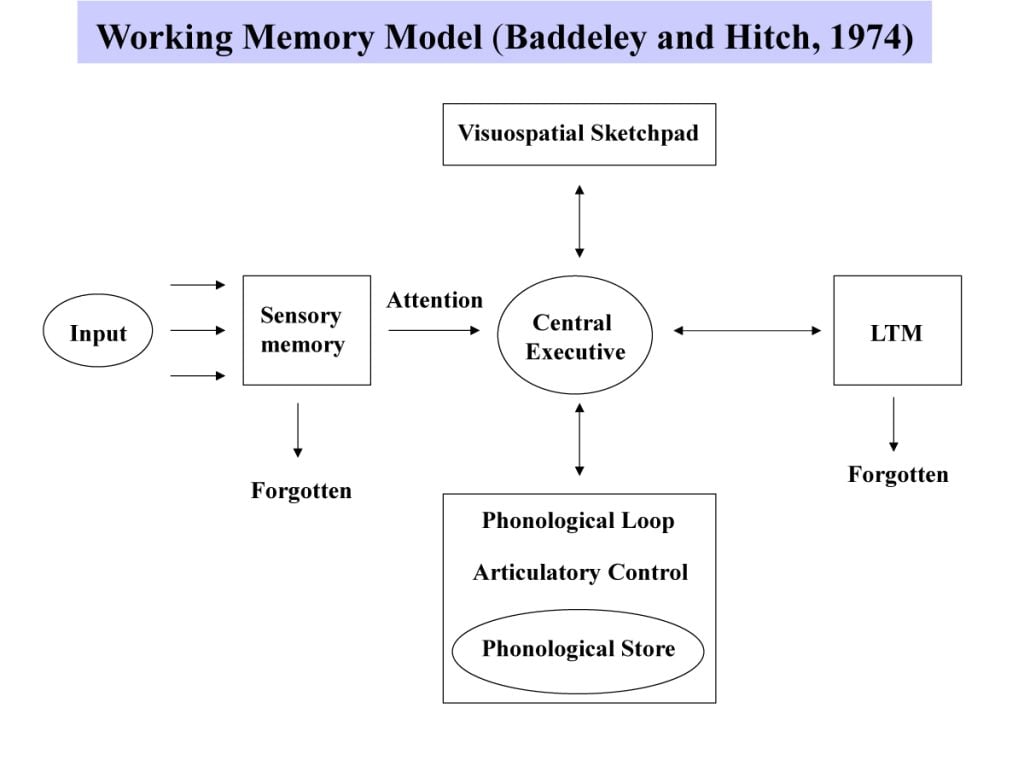
Fig 1. The Working Memory Model Components (Baddeley and Hitch, 1974)
The Central Executive
The Central Executive is like the brain’s manager or conductor.
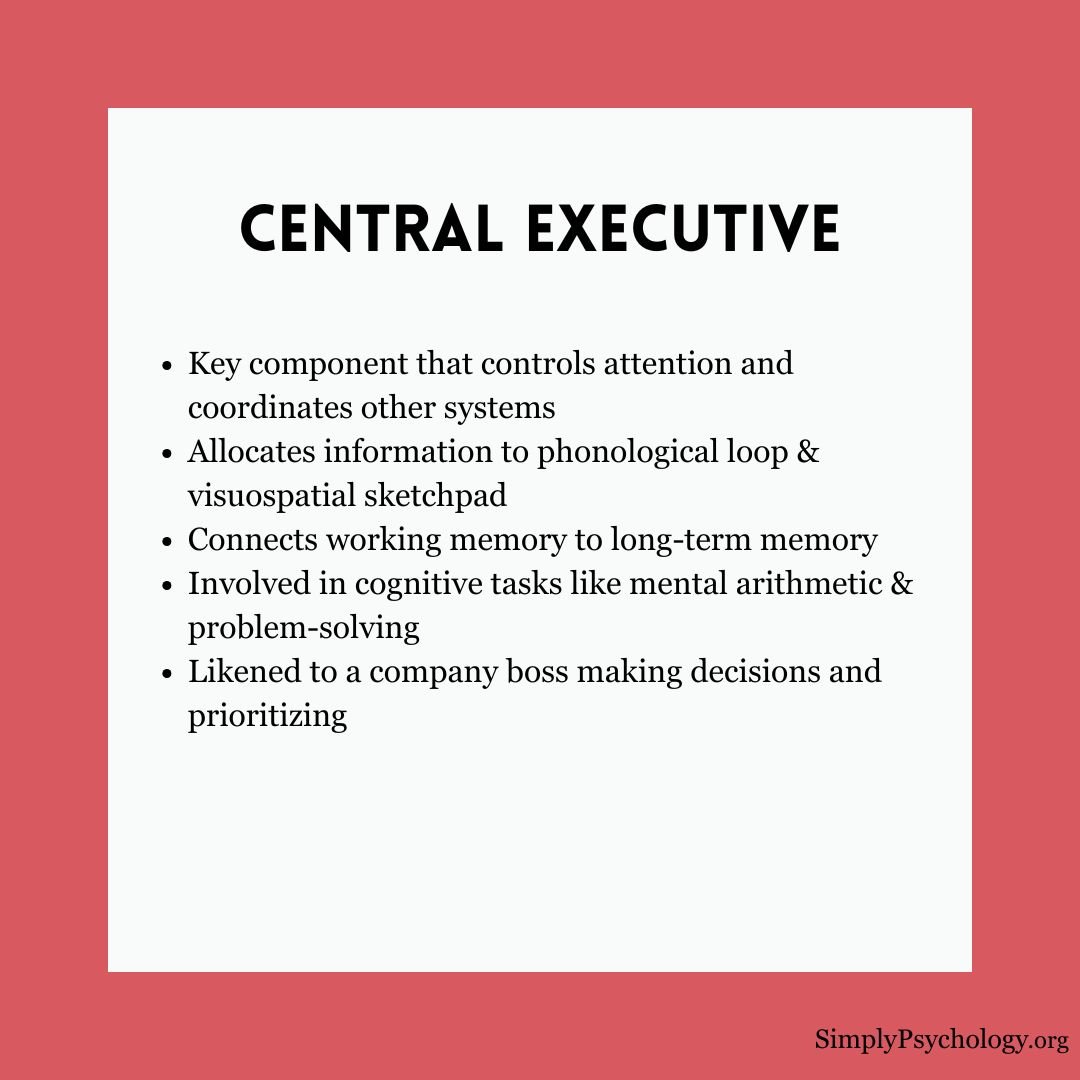
It coordinates and controls how you use your working memory, deciding what information to pay attention to, what to ignore, and what actions to take next.
Think of it as the person directing traffic at a busy intersection—guiding thoughts, prioritizing tasks, and helping you stay focused.
For example, when you’re cooking dinner while answering the phone and watching your kids, it’s your central executive that helps you shift attention smoothly between tasks and stay organized.
If the central executive isn’t working effectively, you might find it hard to concentrate, become easily distracted, or struggle to juggle multiple tasks at once.
Everyday examples of the central executive include:
Deciding to ignore your phone when it rings so you can finish an important task.
Multitasking, such as cooking dinner while helping your child with homework.
Prioritizing tasks by choosing to answer urgent emails first and leaving less important ones for later.
Switching attention from watching TV to listening to someone speaking to you.
Staying focused in noisy environments, like concentrating on work despite conversations happening around you.
Stopping a conversation to focus completely on driving during heavy traffic.
These examples illustrate how the central executive directs attention, manages priorities, and helps you juggle multiple activities effectively.
It coordinates and supervises two assistant systems:
It coordinates and supervises two assistant systems: the phonological loop, which stores sounds and spoken information, and the visuospatial sketchpad, which handles visual images and spatial information.
The central executive also connects these assistants with long-term memory, the brain’s larger database of stored knowledge.
One of the central executive’s main jobs is deciding what information to focus on and directing it to the appropriate assistant system within working memory.
For example, imagine you’re driving a car while having a conversation. Suddenly, a cyclist appears and wobbles into your path.
The central executive immediately steps in, stopping your conversation and directing your full attention to driving safely, helping you avoid an accident.
Unlike the two assistant systems, which mainly store information, the central executive controls attention and decision-making.
It helps you selectively focus on important things while ignoring distractions.
Psychologist Alan Baddeley described the central executive using the metaphor of a company boss.
Just as a boss decides which issues need immediate attention and which ones can wait, the central executive chooses what to prioritize and what to ignore.
It also picks the best strategies for handling problems, but like a busy manager, it can only handle a few tasks effectively at once.
The central executive gathers and combines information from its assistants – the phonological loop and visuospatial sketchpad – as well as retrieving data from the vast storage of long-term memory.
This integration allows you to respond thoughtfully and flexibly to the challenges of everyday life.
What happens if the Central Executive doesn’t work well?
Because the central executive is responsible for coordinating the other working memory components, allocating attention, and managing complex cognitive tasks, its failure significantly disrupts an individual’s everyday life.
Cognitive Impairments
- Inability to Plan and Organize: Individuals struggle to select well-reasoned goals, formulate plans, or solve problems. They cannot organize their thoughts in a meaningful or adaptive way.
- Working Memory Deficits: They have severe difficulties holding and manipulating information in their minds, which makes it hard to mentally compare, contrast, or sequence information.
- Loss of Mental Flexibility: The central executive is responsible for the “shifting function” (switching attention between multiple tasks or mental sets). When impaired, individuals struggle to shift between different perspectives, levels of analysis, or rules.
- Inability to Multitask (Dual-Task Coordination): The central executive is vital for coordinating two tasks simultaneously. For example, patients with Alzheimer’s disease who have central executive impairments show a marked inability to manage dual-task demands (such as tracking a moving object while simultaneously recalling digits), even if they can perform each task perfectly well on its own.
- Poor Inhibitory Control: Individuals lose the ability to deliberately inhibit dominant, automatic, or habitual responses when they are inappropriate for the current situation, and they struggle to resist distracting interference.
The Phonological Loop
The phonological loop is like your brain’s temporary voice recorder – it holds onto spoken or heard information for a short period.
Imagine repeating a phone number silently in your head until you dial it, or repeating directions to yourself to remember them better. That’s your phonological loop at work.
The phonological loop allows you to process language, learn new vocabulary, and follow spoken instructions.
It’s essential for everyday tasks like remembering someone’s name after being introduced, repeating items on a grocery list, or mentally rehearsing what you’ll say before speaking.
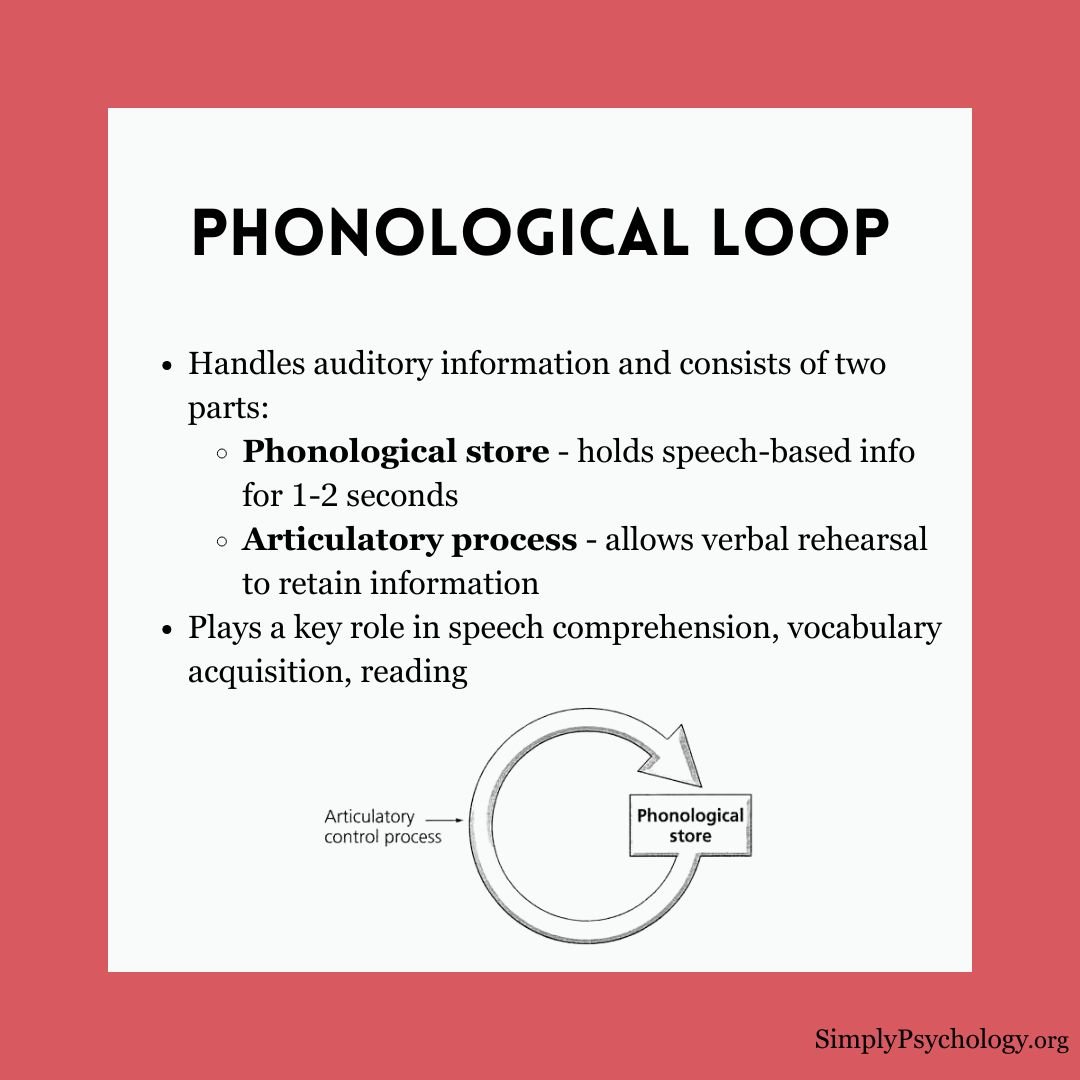
The phonological loop is the part of working memory that deals with spoken and written material.
It consists of two parts (see Figure 2).

Fig 2 . The phonological loop
- The inner ear (phonological store): This part briefly holds information in a speech-based form (i.e., spoken words) for 1-2 seconds.
Spoken words enter the store directly. Written words must first be converted into an articulatory (spoken) code before they can enter the phonological store.
The inner voice (articulatory rehearsal system): This part silently repeats the sounds or words, helping you remember them longer.
This is how we remember a telephone number we have just heard. As long as we keep repeating it, we can retain the information in working memory.The articulatory control process also converts written material into an articulatory code and transfers it to the phonological store.
The Visuospatial Sketchpad
The visuospatial sketchpad is like a mental drawing board or inner eye in your brain. It temporarily holds visual information (like pictures, shapes, and colors) and spatial information (such as locations or movements).
For example, when you imagine rearranging furniture in your room or mentally picture the route from your home to a friend’s house, you’re using your visuospatial sketchpad.
It helps you visualize objects, remember visual details, and plan movements.
It has two main jobs:
Visual tasks: Handling details like color, shape, and appearance (for example, picturing a friend’s face or recalling what your car looks like).
Spatial tasks: Managing information about positions, directions, and movements (such as mentally navigating your way to a familiar store or arranging furniture in a room).
Essentially, the visuospatial sketchpad helps you manage and work with visual and spatial information, enabling you to plan, organize, and interact effectively with the world around you.
In everyday life, the visuospatial sketchpad helps you:
Mentally plan and follow directions while driving or walking.
Judge if a parking spot is large enough for your car.
Mentally retrace your steps when trying to find lost keys.
Imagine how clothes will look together before getting dressed.
Arrange ingredients on a pizza or toppings on a sandwich.
Visualize diagrams or maps to solve problems.
Overall, this system lets you create and manipulate mental images, helping you navigate your physical environment and perform tasks that rely on visual imagination and spatial awareness.
The Episodic Buffer
The original model was updated by Baddeley (2000) after the model failed to explain the results of various experiments.
An additional component was added called the episodic buffer.
The episodic buffer acts as a “backup” store which communicates with both long-term memory and the components of working memory.

Fig 3 . Updated Model to include the Episodic Buffer
The episodic buffer is like your mind’s temporary storage box, bringing together different kinds of information from various sources and combining them into meaningful “episodes” or experiences.
Imagine it as your brain’s internal editor or storyteller, mixing visual details, sounds, emotions, and memories into one coherent scene.
For example, when you recall a recent birthday party, the episodic buffer combines the faces you saw, the conversations you heard, and the feelings you experienced into a unified memory.
It has two key roles:
Combining information from different parts of working memory (like the phonological loop and visuospatial sketchpad).
Connecting working memory to long-term memory, allowing you to relate current experiences to past events and stored knowledge.
In daily life, the episodic buffer helps you:
Recall stories or movies by integrating images, sounds, and emotions.
Follow complex conversations by keeping track of what’s been said.
Imagine future events, such as planning a vacation, by combining details you’ve previously seen or experienced.
Understand written text by linking together sentences and paragraphs into a meaningful whole.
Tthe episodic buffer helps you create a rich, coherent understanding of your experiences by blending information from your senses, working memory, and long-term memory into clear and meaningful mental episodes.
Strengths
1. Superior Explanatory Power and Complexity
A major strength of the working memory model is its sophisticated explanatory power.
It allows psychologists to explain a wide range of observed memory phenomena that the older Multi-Store Model (MSM) could not account for. For example, the model specifically explains:
- The Phonological Similarity Effect: Why lists of words that sound similar are harder to remember than words that sound different (because they confuse the phonological loop).
- The Word-Length Effect: Why we can remember more short words than long words (because longer words take more time to subvocally articulate in the phonological loop).
- Articulatory Suppression: Why repeating a meaningless sound (like “the, the, the”) disrupts verbal memory (it blocks the “inner voice” and fills the capacity of the phonological loop).
2. Focus on Active Processing
Unlike earlier models that viewed short-term memory merely as a passive “stopping-off station” or gateway where information waits to enter long-term memory, the working memory model recognizes short-term storage as an active workspace.
It successfully accounts for how we can temporarily store information while simultaneously manipulating it to perform complex cognitive tasks, such as reading comprehension, reasoning, and mental arithmetic.
3. Support from Dual-Task Studies
The model is heavily supported by empirical evidence from “dual-task” techniques. The model posits that the “slave systems” (the phonological loop and the visuo-spatial sketchpad) have limited processing capacities and act independently.
The working memory model makes the following two predictions:
1. If two tasks make use of the same component (of working memory), they cannot be performed successfully together.
2. If two tasks make use of different components, it should be possible to perform them as well as together as separately.
Key Study: Baddeley and Hitch (1976)
- Aim: To investigate if participants can use different parts of working memory at the same time.
- Method: Conducted an experiment in which participants were asked to perform two tasks at the same time (dual task technique) – a digit span task which required them to repeat a list of numbers, and a verbal reasoning task which required them to answer true or false to various questions (e.g., B is followed by A?).
- Results: As the number of digits increased in the digit span tasks, participants took longer to answer the reasoning questions, but not much longer – only fractions of a second. And, they didn”t make any more errors in the verbal reasoning tasks as the number of digits increased.
- Conclusion: The verbal reasoning task made use of the central executive and the digit span task made use of the phonological loop.
4. Neuropsychological and Clinical Evidence
Case studies of brain-damaged patients provide compelling physiological evidence for the model’s separate components.
- Partial Deficits: Because working memory has multiple components, a brain injury can damage one system while leaving the others intact. For example, a patient known as K.F. (and another known as P.V.) suffered brain damage that severely impaired their auditory/verbal short-term memory (a damaged phonological loop), but their ability to process visual information remained entirely normal (an intact visuo-spatial sketchpad).
- Brain Imaging: Modern neuroimaging techniques, such as PET and fMRI scans, corroborate this by showing that distinctly different areas of the brain “light up” depending on whether a task activates the phonological loop or the visuo-spatial sketchpad.
Brain Imaging Studies
Several neuroimaging studies have attempted to identify distinct neural correlates for the phonological loop and visuospatial sketchpad posited by the multi-component model.
For example, some studies have found that tasks tapping phonological storage tend to activate more left-hemisphere perisylvian language areas, whereas visuospatial tasks activate more right posterior regions like the parietal cortex (Smith & Jonides, 1997).
However, the overall pattern of results remains complex and controversial. Meta-analyses often fail to show consistent localization of verbal and visuospatial working memory (Baddeley, 2012).
There is significant overlap in activation, which may reflect binding processes through the episodic buffer, as well as common executive demands.
Differences in paradigms and limitations of neuroimaging methodology further complicate mapping the components of working memory onto distinct brain regions or circuits (Henson, 2001).
While neuroscience offers insight into working memory, Baddeley (2012) argues that clear anatomical localization is unlikely given the distributed and interactive nature of working memory.
Specifically, he suggests that each component likely comprises a complex neural circuit rather than a circumscribed brain area.
Additionally, working memory processes are closely interrelated with other systems for attention, perception and long-term memory.
Thus, neuroimaging provides clues but has not yet offered definitive evidence to validate the separable storage components posited in the multi-component framework.
Further research using techniques with higher spatial and temporal resolution may help better delineate the neural basis of verbal and visuo-spatial working memory.
5. Insight into Language Acquisition
By separating components, the model has provided valuable insights into evolutionary psychology and human development.
Baddeley suggested that the phonological loop did not just evolve to help us remember telephone numbers, but rather as a specialized mechanism for language learning.
Developmental research supports this, showing a strong correlation between a young child’s capacity to use the phonological loop (e.g., their ability to repeat non-words) and their subsequent vocabulary development.
6. Reduced Reliance on Rote Rehearsal
Earlier models overemphasized the role of rote rehearsal (simply repeating information over and over) as the only way to transfer information into long-term memory.
The working memory model treats verbal rehearsal as an optional process housed within the phonological loop, which is a much more realistic reflection of how human memory actually functions.
Weaknesses
Lieberman (1980) criticizes the working memory model as the visuospatial sketchpad (VSS) implies that all spatial information was first visual (they are linked).
However, Lieberman points out that blind people have excellent spatial awareness, although they have never had any visual information.
Lieberman argues that the VSS should be separated into two different components: one for visual information and one for spatial.
There is little direct evidence for how the central executive works and what it does. The capacity of the central executive has never been measured.
Working memory only involves STM, so it is not a comprehensive model of memory (as it does not include SM or LTM).
The working memory model does not explain changes in processing ability that occur as the result of practice or time.
1. Vague and Poorly Understood Central Executive
The most frequent criticism of the working memory model is its lack of clarity regarding the central executive.
Even Alan Baddeley, one of the model’s creators, admitted that the central executive is the most important but least understood component of the entire system.
- The “Homunculus” Problem: Critics argue that the central executive functions too much like a theoretical “homunculus” (a little man inside the head) or a “ragbag” used to conveniently explain away any confusing experimental results. If any cognitive outcome can be attributed to the central executive, it makes the theory difficult to test and develop.
- Undefined Subcomponents: Describing the central executive simply as an “attentional” system is considered unsatisfactory. While it is responsible for coordinating tasks, it is difficult to identify the exact number and nature of the executive processes it handles, because most complex cognitive tasks require the use of multiple executive functions simultaneously.
2. Difficulties with Empirical Testing and Falsifiability
Because the working memory model is highly sophisticated and contains multiple interacting subcomponents, it is hard to test empirically in its entirety.
- Experimental studies are typically designed to test only one specific aspect of the model at a time (e.g., isolating the phonological loop using articulatory suppression).
- Due to this piecemeal testing and the existence of multiple potential explanations for the same experimental result, the overarching model is difficult to truly falsify.
3. Ambiguity Surrounding the Episodic Buffer
The original 1974 model consisted of only three components, which were too separate to explain how verbal and visual information were combined, or how working memory interfaced with long-term memory.
To fix this, the episodic buffer was added 25 years later, in 2000. However, this addition introduced new theoretical weaknesses:
- We still lack a detailed account of exactly how the episodic buffer integrates information from the other components and from long-term memory.
- Because the episodic buffer has a mixed functional nature, some theorists suggest it might actually just be a part of the central executive rather than a separate storage component. This blurs the model’s original strict boundary between “storage” buffers and “control” mechanisms, complicating the theory further.
4. Oversimplification of the Visuo-Spatial Sketchpad
Critics argue that treating visual and spatial memory as a single “sketchpad” is too simplistic.
The visuo-spatial sketchpad should be further divided into two entirely separate components dedicated specifically to:
- Visual information (such as shape and color, sometimes called the “visual cache”).
- Spatial information (such as movement and spatial arrangement, sometimes called the “inner scribe”).
5. Narrow Focus on Short-Term Processing
Fundamentally, the working memory model is essentially a “zoom-in” on the structure of short-term memory.
Because of this narrow focus, it has been criticized for not taking other memory structures into account, such as sensory memory, and for failing to fully detail the complex, bidirectional flow of information between working memory and long-term memory.
Educational Applications
How does working memory affect academic performance?
Working memory significantly influences academic performance by underpinning many core classroom activities, including learning new information, reading comprehension, writing, mathematics, and problem-solving.
1. Foundation for Learning Tasks:
Working memory enables students to temporarily hold and manipulate information essential for classroom tasks.
For example, when solving multi-step math problems, students must maintain intermediate solutions in memory while simultaneously processing further calculations.
Similar demands occur in writing, where students hold sentence structures and ideas in mind while physically writing them down.
2. Reading Comprehension:
Working memory facilitates reading by allowing students to remember previously read words and sentences while integrating them with incoming text to understand overall meaning.
Children with weaker working memory struggle more with comprehension, particularly when reading complex or unfamiliar texts.
3. Writing and Communication:
Effective writing requires working memory to hold multiple ideas, grammar rules, and sentence structures simultaneously.
Students with working memory difficulties may frequently lose track of their ideas, omit important details, or repeat themselves, resulting in weaker written work and less coherent communication.
4. Following Instructions:
Students with limited working memory struggle to follow multi-step instructions because they forget intermediate or later stages.
This difficulty significantly impacts their ability to participate effectively in classroom activities, leading to incomplete or incorrect task completion, ultimately affecting their overall academic progress.
5. Academic Achievement:
Research consistently finds a strong correlation between working memory capacity and educational attainment.
Students with stronger working memory capabilities typically perform better academically, as demonstrated by higher results in standardized tests like Key Stage assessments.
6. Learning New Material:
Students with reduced working memory capacity take longer to assimilate new knowledge, struggling to connect new information to existing knowledge structures (schemas).
This slower integration negatively impacts the speed and efficiency of their learning process.
Consequences for Education:
Teachers need to structure learning environments to reduce cognitive load and provide external aids and memory-support strategies.
Without these supports, students with working memory limitations often fall behind academically, not because of lower intelligence, but because they cannot effectively manage the cognitive demands of typical classroom activities.
Working Memory and ADHD/Learning Disorders
Working memory plays a significant role in conditions like ADHD and learning disabilities, which often involve challenges with attention, organization, and information processing.
Children with ADHD or dyslexia frequently rely heavily on their working memory – like a mental notepad – just to keep track of instructions or stay organized.
This extra cognitive effort means they have less working memory available for other tasks, leading to common difficulties such as forgetting instructions, losing track of tasks, or becoming easily distracted.
Practical examples include a child with ADHD struggling to remember multi-step instructions from a teacher because their working memory is already stretched thin by trying to focus and filter out distractions.
Similarly, a child with dyslexia might struggle to retain and manipulate the sounds of words in their working memory, making reading and spelling more challenging.
Imagine a student’s working memory is like a bucket that holds water.
Each new piece of information (such as instructions, steps for an assignment, or new vocabulary words) is like adding drops of water into the bucket. Ideally, the bucket steadily fills up, allowing the student to retain and use the information.
However, for students who struggle with working memory (like those with ADHD or learning disabilities), the bucket may have holes or leaks.
No matter how carefully you add water (information), some of it continually drains out.
This means the student quickly forgets instructions, struggles with multi-step tasks, or appears easily distracted – not because they’re not trying, but because their “bucket” can’t hold information as effectively as others.
Understanding these connections is especially valuable for parents, educators, and caregivers, as it helps explain everyday behaviors seen in children with ADHD or learning disorders.
This awareness can lead to more effective strategies and accommodations, such as breaking tasks into smaller steps, providing visual supports, or using external reminders to reduce the cognitive load on working memory.
As a teacher, recognizing this analogy helps you adjust how you deliver instructions or content. For instance, you could:
-
Provide information in smaller chunks (fewer drops at a time).
-
Use frequent repetition and reminders (refilling the bucket periodically).
-
Give visual aids or written instructions (like placing a container underneath the bucket to catch drips).
What strategies improve working memory?
Targeted training programs claiming to improve working memory generally have limited practical impact.
Although students may improve on the specific tasks practiced during training, these improvements rarely transfer to broader cognitive functions or real-world academic tasks.
As a result, such training is not recommended as an effective strategy for improving working memory capacity or classroom performance.
While direct improvement of working memory capacity through specific training is ineffective, teachers can significantly mitigate working memory challenges through practical, supportive strategies.
These strategies help students better manage their existing working memory capacity, thereby improving their ability to successfully engage with academic tasks and enhancing overall classroom performance
Effective Classroom Strategies to Manage Working Memory Limitations:
1. Reduce Task Complexity
Teachers should aim to limit cognitive load by simplifying tasks:
-
Break down instructions: Provide step-by-step guidance rather than complex instructions.
-
Clarify task objectives: Clearly state the purpose of the task, ensuring students understand precisely what is required.
-
Use clear, simple language: Avoid overly complicated sentences with multiple clauses.
-
Simplify visual presentation: Minimize unnecessary distractions, like complex fonts or irrelevant images, as these can divert attention and overload working memory.
2. Provide Memory Aids (Externalizing Cognitive Load)
Memory aids or tools help students offload cognitive demands onto external resources, reducing the load on working memory. Examples include:
-
Visual Prompts: Lists, diagrams, multiplication grids, number lines, or graphic organizers that students can refer to during tasks.
-
Classroom Displays: Effective classroom displays should be clear, uncluttered, and directly supportive of current learning tasks. Teachers should explicitly teach students how to use these aids efficiently.
-
Technological Tools: Devices such as digital voice recorders or educational software, helping students to retain instructions or complex information.
3. Establish and Reinforce Routines
Predictable classroom routines help automate basic processes, thereby freeing working memory for more demanding cognitive tasks:
-
Routine behaviors: Establishing clear routines for common tasks (e.g., start-of-day procedures, transitions, homework checking).
- Following multi-step instructions: such as “Put away your books, take out your spelling book, write the date, and face the front.”
-
Learning routines: Using familiar frameworks or sequences for teaching activities, such as regularly structured classroom discussions, consistent formatting of worksheets, or repeated instructional formats.
4. Chunking Information
Grouping information into meaningful units (“chunks”) makes it easier to remember and manipulate:
-
Mnemonic strategies: Employing familiar acronyms (like BIDMAS for order of mathematical operations) or rhymes (such as historical sequences).
-
Explicit chunking techniques: Teaching students to group related ideas or concepts to streamline recall and processing.
5. Note-Taking and Externalization
Encouraging students to externalize information through note-taking, thereby relieving working memory demands:
-
Structured note-taking: Using simple outlines or concept maps to organize information visually.
-
Accessible note-taking resources: Providing easy access to notepads, whiteboards, or digital devices, allowing students to quickly record important points or instructions.
6. Explicitly Teaching Memory-Supporting Strategies
Explicit instruction in strategies that students can independently employ to manage working memory demands:
-
Rehearsal: Encouraging students to repeat information mentally or verbally to help retain it temporarily (effective for short-term retention).
-
Requesting Help: Training students to recognize when they are struggling and to proactively request clarification, repeated instructions, or reminders.
-
Leveraging Long-Term Memory: Encouraging students to link new information to familiar concepts already stored in their long-term memory. Activating prior knowledge helps ease the cognitive burden placed on working memory.
References
Atkinson, R. C., & Shiffrin, R. M. (1968). Chapter: Human memory: A proposed system and its control processes. In Spence, K. W., & Spence, J. T. The psychology of learning and motivation (Volume 2). New York: Academic Press. pp. 89–195.
Baddeley, A. D. (1986). Working memory. Oxford: Oxford University Press.
Baddeley, A. (1996). Exploring the central executive. The Quarterly Journal of Experimental Psychology Section A, 49(1), 5-28.
Baddeley, A. D. (2000). The episodic buffer: A new component of working memory? Trends in Cognitive Sciences, 4, (11): 417-423.
Baddeley, A. (2010). Working memory. Current biology, 20(4), R136-R140.
Baddeley, A. (2012). Working memory: Theories, models, and controversies. Annual review of psychology, 63, 1-29.
Baddeley, A. D., & Hitch, G. (1974). Working memory. In G.H. Bower (Ed.), The psychology of learning and motivation: Advances in research and theory (Vol. 8, pp. 47–89). New York: Academic Press.
Baddeley, A. D., & Lieberman, K. (1980). Spatial working memory. ln R. Nickerson. Attention and Performance, VIII. Hillsdale, N): Erlbaum.
Borella, E., Carretti, B., Sciore, R., Capotosto, E., Taconnat, L., Cornoldi, C., & De Beni, R. (2017). Training working memory in older adults: Is there an advantage of using strategies?. Psychology and Aging, 32(2), 178.
Chai, W. J., Abd Hamid, A. I., & Abdullah, J. M. (2018). Working memory from the psychological and neurosciences perspectives: a review. Frontiers in Psychology, 9, 401.
Cowan, N. (1995). Attention and memory: An integrated framework. Oxford Psychology Series, No. 26. New York: Oxford University Press.
Cowan, N. (2005). Working memory capacity. Exp. Psychology, 54, 245–246.
Cowan, N. (2008). What are the differences between long-term, short-term, and working memory?. Progress in brain research, 169, 323-338.
Cowan, N. (2022). Working memory development: A 50-year assessment of research and underlying theories. Cognition, 224, 105075.
Curtis, C.E., & D’Esposito, M. (2003). Persistent activity in the prefrontal cortex during working memory. Trends in Cognitive Sciences, 7(9), 415-423.
D’Esposito, M. (2007). From cognitive to neural models of working memory. Philosophical Transactions of the Royal Society B: Biological Sciences, 362(1481), 761-772.
D’Esposito, M., & Postle, B. R. (2015). The cognitive neuroscience of working memory. Annual review of psychology, 66, 115-142.
Fell, J., & Axmacher, N. (2011). The role of phase synchronization in memory processes. Nature Reviews Neuroscience, 12(2), 105-118.
Gathercole, S. E., Pickering, S. J., Ambridge, B., & Wearing, H. (2004). Working memory skills and educational attainment: Evidence from National Curriculum assessments at 7 and 14 years of age. Applied Cognitive Psychology, 40, 1-16.
Harrison, S. A., & Tong, F. (2009). Decoding reveals the contents of visual working memory in early visual areas. Nature, 458(7238), 632-635.
Henson, R. (2001). Neural working memory. In J. Andrade (Ed.), Working memory in perspective (pp. 151-174). Psychology Press.
Klein, K., & Boals, A. (2001). The relationship of life event stress and working memory capacity. Applied Cognitive Psychology: The Official Journal of the Society for Applied Research in Memory and Cognition, 15(5), 565-579.
Lewis-Peacock, J. A., & Postle, B. R. (2008). Temporary activation of long-term memory supports working memory. Journal of Neuroscience, 28(35), 8765-8771.
Lieberman, M. D. (2000). Introversion and working memory: Central executive differences. Personality and Individual Differences, 28(3), 479-486.
Osaka, M., Osaka, N., Kondo, H., Morishita, M., Fukuyama, H., Aso, T., & Shibasaki, H. (2003). The neural basis of individual differences in working memory capacity: an fMRI study. NeuroImage, 18(3), 789-797.
Serences, J.T., Ester, E.F., Vogel, E.K., & Awh, E. (2009). Stimulus-specific delay activity in human primary visual cortex. Psychological Science, 20(2), 207-214.
Smith, E.E., & Jonides, J. (1997). Working memory: A view from neuroimaging. Cognitive Psychology, 33(1), 5-42.
Waterman, A., & Miller, M. (n.d.). Working memory: A practical guide for teachers. Centre for Applied Education Research. Retrieved from https://www.caer.org.uk



How is working memory tested?
Working memory is evaluated using a variety of standardized clinical assessments and experimental cognitive tasks that measure an individual’s ability to temporarily hold, manipulate, and coordinate information.
Here are the primary methods and tests used to assess working memory:
1. Memory Span Tasks
Span tasks are among the most common ways to measure the capacity of working memory. These tasks typically establish a person’s limit for holding information in mind without active rehearsal.
- Digit Span: A person is read a random sequence of numbers and asked to repeat them back immediately,. The normal forward digit span is roughly seven items, plus or minus two. The test can also be made more difficult by asking the individual to recite the numbers in reverse order (Digit Span Backward), which requires them to actively manipulate the information in their head,.
- Spatial Span: Used to test the visuo-spatial component of working memory, this involves remembering and reproducing a sequence of spatial locations, both forward and backward,.
- Letter-Number Sequencing: A person is presented with a mixed sequence of letters and numbers and asked to recall the numbers in numerical order followed by the letters in alphabetical order,.
2. The N-Back Task
The N-back task is a continuous performance test used to evaluate how varying loads of information affect working memory.
- Participants are shown a continuous stream of items (such as letters) one at a time.
- For each item, they must decide whether it matches the item presented N positions back in the sequence (e.g., 1-back, 2-back, or 3-back).
- This task isolates working memory load by keeping the identity and order of the items constant while simply changing the “N” criteria, allowing researchers to observe how performance and brain activity change as the cognitive demand increases.
3. Dual-Task and Complex Span Paradigms
Because the central executive component of working memory is responsible for coordinating multiple tasks and manipulating data, tests often force participants to juggle two tasks simultaneously.
- Complex Span Tests: A classic example involves asking a participant to verify whether an arithmetic problem is correct (e.g., “(5 x 3) + 4 = 17?”) and then memorize a word that immediately follows it,. After completing a series of these math-word combinations, the participant must recall all the words in order, effectively testing their working memory capacity under cognitive strain.
- Articulatory Suppression: In an experimental setting, individuals may be asked to memorize visual or spatial information while simultaneously vocalizing a repetitive, irrelevant sound (like counting “one-two-three” or saying “the, the, the” out loud). This disrupts the “phonological loop” (the inner voice used for rehearsal) and forces the brain to rely on other working memory components.
4. Delayed Response Tasks
This is a standard test for working memory that assesses how well someone can maintain information “online” over a brief period of time.
- A stimulus is presented (such as a light appearing over a specific door), and then removed.
- After a short delay period of a few seconds, the participant must respond to the initial stimulus (e.g., identifying the correct door).
- Another variation is Sternberg’s item recognition task, where a small memory set of digits is briefly shown, followed by a minimal delay, and then a single “probe” item is presented. The participant must respond as quickly as possible with a “yes” or “no” regarding whether the probe was in the original set, which measures the speed at which working memory can be accessed and scanned.
5. Standardized Clinical Batteries
Working memory is a core component of general intelligence and cognitive health, so it is deeply integrated into formal intelligence testing:
- Wechsler Scales: The Wechsler Adult Intelligence Scale (WAIS-IV) and the Wechsler Intelligence Scale for Children (WISC-V) both calculate a specific Working Memory Index,,. This index gauges the attention, concentration, and mental manipulation skills necessary for higher-order thinking.
- MATRICS Consensus Cognitive Battery (MCCB): This standardized clinical battery is specifically used to assess cognitive domains, including working memory, for pharmacological trials and in populations with conditions like schizophrenia.